

AI’s Next Leap: Built on Verifiable Agents and Trusted Data with UWI
Identity, Money, and Objects – Unlocking Agentic AI
Jun 28 2025With 1 in 3 companies actively exploring ways to integrate agentic AI into their business workflows, and 97 percent of business leaders viewing generative AI as a game-changing technology - the stage is set to fundamentally reimagine how business gets done. We are entering a new era: before AI, and after. Yet, despite this unprecedented momentum, scaling AI and moving agents into production remains complex for reasons that are deeply rooted in data quality, trust and regulatory friction. Specifically for agents there are important considerations to be made. While progress is being made on defining agent to agent communication protocols to bring interoperability for agentic AI ecosystems, the ability to provide agents with a verifiable identity becomes critical. Ideally, with the appropriate consent and delegation from users, AI agents have the potential to become active participants in our digital systems. For this to happen providing agents with a verifiable identity will be non-negotiable.
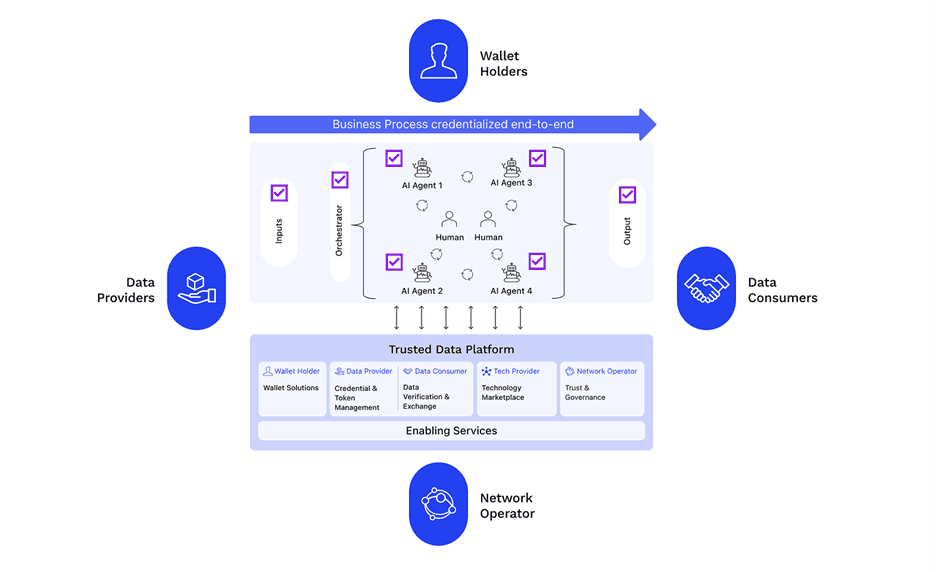
This is where UWI - positioned as a trusted data platform that can provide high quality verified data as well as the backbone to provide both humans and agents with verifiable identities and credentials, has a strong and unique value proposition. AI and Agentic applications can be built on top of UWI to benefit from verified data directly shared by users, from their wallets, with the right permissions for usage and consent in place from the get-go.
Why UWI is uniquely positioned to scale AI and Agentic Applications
UWI is specifically designed to provide a foundational layer that provides secure and efficient management of digital identity, money and objects. It unlocks streamlined verification capabilities and allows verifiable credentials to be seamlessly embedded into core business processes.
AI, but agents in particular, can benefit from these capabilities especially as the notion of identity can now be extended beyond humans and organizations to include agents and machines. For example, from a UWI perspective there should be no difference in providing an agent with a verifiable identity that has associated credentials. These credentials can be leveraged within workflows and processes where humans, enterprises, and agents interact. This vision of seamless, trust-based collaboration between intelligent systems and humans lies at the core of UWI’s approach.
Technical Building blocks to realize this Agentic vision
Scaling agentic systems requires a shift in how digital infrastructure is designed. It's no longer enough to simply store and verify data - we need components that can support autonomous decision-making, enforce consent, and maintain privacy and data security across distributed environments.
UWI is being built with a solid modular foundation and the required technical building blocks to support this evolution are Hybrid Wallet architecture, Confidential Computing, Consent Management & Delegation and Identity for Agents. These elements are critical to enabling agents to operate with trust, resilience, and user control embedded by design.
The Hybrid Wallet is a next-generation wallet model that combines on-device control with delegated cloud operations, designed to overcome limitations around offline availability and recovery. While preserving the full capabilities of mobile wallets such as secure credentials, assets, offline interactions, and user-controlled data storage - it introduces a trusted cloud component that adds support for seamless recovery and automation. This cloud layer uses advanced security techniques to act on credentials while ensuring underlying data is protected, even from the cloud operator, thus assuring data privacy across storage, transit, and use. This architecture lays the foundation for scalable, agentic automation without compromising on user control or reliability.
Consent Management and Delegation: Consent is shifting from a singular, disjointed event to a cohesive, seamless relationship. Instead of static checkboxes, what’s needed is a dynamic system that builds trust over time. UWI is building a System of Trust that considers these four dimensions:
• Connection – Sets the level of scrutiny for a data request. The depth of Context, Clarity, and Control required depends on who is requesting access and how they are verified.
• Context – Sets clear terms, scope, and conditions upfront to move beyond all-or-nothing data sharing.
• Clarity – Ensures users understand what data is shared, for how long, and with whom.
• Control – Allows users to manage or revoke access at any time, maintaining trust over the long term.
Confidential Computing is a security paradigm that protects data not just at rest or in transit, but also during processing. It uses Trusted Execution Environments (TEEs), which are secure, isolated areas of memory built into modern CPUs. These private enclaves protect data ensuring that no unauthorized party including the operating system, hypervisor, or cloud provider—can view, modify, or insert data, even at the hardware level. This guarantees the confidentiality and integrity of computations, enabling secure processing of sensitive information in untrusted environments. The Hybrid wallet could integrate confidential computing to ensure secure processing of sensitive data, even in untrusted cloud environments. It empowers these wallets to evolve from passive storage tools to intelligent, autonomous agents that can safely interact with AI and other services. In a way, it forms the trust foundation for hybrid wallets, enabling secure processing of sensitive data, even in the cloud.
Identity for Agents: In an agentic ecosystem, establishing verifiable identities for agents is essential to ensure trust, accountability, and secure interactions. By applying identity principles, each agent can be issued an identity and a set of Verifiable Credentials (VCs). These credentials define the agent's role, capabilities, and endpoints. With identity in place, agents can authenticate with others and operate securely, based on verifiable trust rather than pre-established connections. This opens the door to building dynamic agent discovery systems, where agents can assess the trustworthiness of peers before engaging. Verifiable credentials can also be used to prove things like certifications or past activity, making it easier to create more autonomous and reliable AI workflows.
AI Agents for UWI
From Infrastructure to Intelligence
With foundational building blocks like identity, consent, credentials, and confidentiality in place, UWI sets the stage for the next leap: intelligence and automation. This is where AI agents come in.
AI agents are autonomous systems that perceive their environment, make decisions, and act to achieve specific goals. Combining reasoning, learning, and interaction, they are rapidly gaining traction across industries.
Building on our earlier exploration of how UWI powers hyper-personalized AI experiences through trusted, user-shared data, we now turn to the enterprise opportunity.
UWI’s architecture is inherently composable by design, allowing it to evolve with new technologies and standards. This enables the creation of multi-agentic, cross-enterprise AI networks, where agents from different organizations can connect with one another, as well as with humans and systems, to jointly execute workflows powered by trusted data.
Such networks offer a distinct edge: they enable automation, personalization, and interoperability without compromising consent or compliance. For enterprises already investing in AI, UWI-powered agents unlock access to zero-party data directly from users. This verified data can be seamlessly combined with existing enterprise data in systems like SAP, Salesforce, Oracle, and others.
What Agentic AI Looks Like with UWI
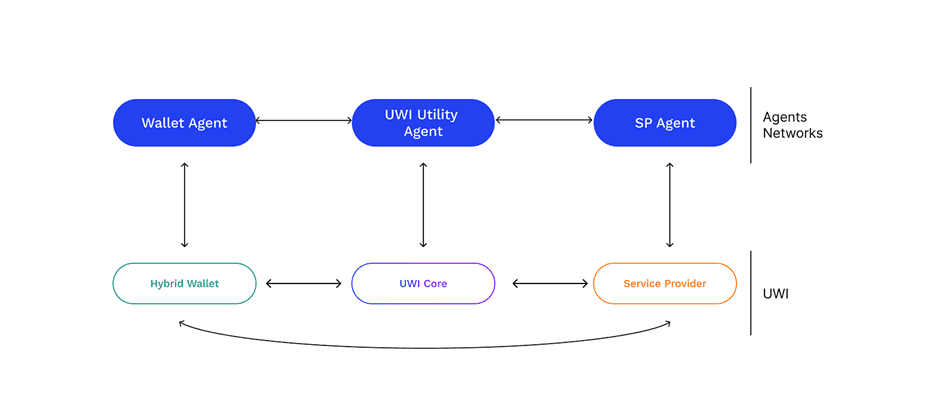
In practice, agents operate on top of UWI within confidential environments supported by TEEs, collecting explicit consent or delegation from users. This forms an agentic infrastructure made up of specialized agents:
Wallet Agents act on behalf of users, requiring explicit consent to perform tasks. They’re closely tied to the Hybrid Wallet.
UWI Utility Agents run on the UWI Core SDK, handling operational tasks like issuing or revoking credentials.
Service Provider Agents represent third parties (e.g., airlines, governments, enterprises) and interact with other agents to request or manage verifiable credentials—only with user consent and delegation.
Ideally, each user would have a dedicated Wallet Agent (often managed by the Hybrid Wallet provider), with multiple Service Provider Agents interacting as needed. UWI Utility Agents can be run by UWI or other trusted entities to support custom logic.
Scaling Agentic Ecosystems: MCP and A2A
As these agents begin to collaborate across systems and organizational boundaries, the need for interoperability and standardization becomes critical to boost adoption and scale agentic networks for large-scale enterprises. That is exactly the reason why the industry is on fire these days, when it comes to protocols like MCP and A2A. But let’s see what they are and what they mean for UWI:
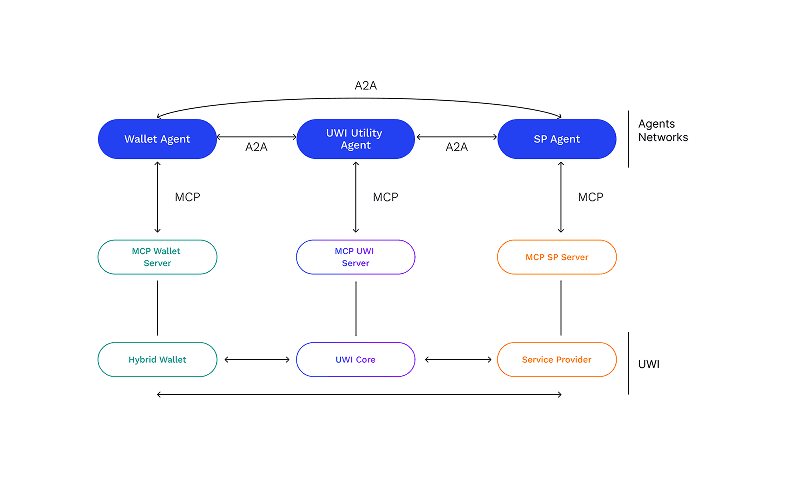
• Model Context Protocol (MCP): MCP defines a standardized way for agents to exchange contextual information about AI models, task definitions, and execution roles. By establishing a shared language and structure, MCP ensures agents from different vendors or systems can interoperate, compose workflows, and maintain continuity across complex operations.
• Agent-to-Agent (A2A) Interactions: A2A flows enable agents to securely delegate tasks, share verifiable data, and coordinate actions without human input. These interactions are being implemented in real-world scenarios, allowing Wallet Agents and Service Provider Agents to operate within secure, confidential environments.
These protocols, combined with the governance capabilities, form the backbone for trusted interactions and can help deliver what we define as composable agentic networks.
Enabling such composability and interoperability requires UWI to offer standard interfaces to leverage UWI data and capabilities in a way that Service Providers can seamlessly integrate their agents, connect their servers, and expose domain-specific knowledge for orchestrating advanced, multi-agent flows.
Strong agent identity is essential for protecting sensitive data, ensuring accountability, and enabling secure automation. By combining verifiable identity with standardized A2A protocols, UWI can unlock high-trust, cross-domain scenarios that were previously too complex or risky to implement.
For example: A government benefits agent could securely retrieve verified employment data from a payroll agent - automating eligibility checks with user consent. In mobility, a car digital rental assistant could access verified driver credentials from an insurance agent to streamline onboarding, without exposing sensitive information, and with full traceability.
These capabilities position UWI to lead in building secure, interoperable, and composable agentic ecosystems across industries.
Example Scenario: Managing a Travel Delay with UWI, MCP, and A2A
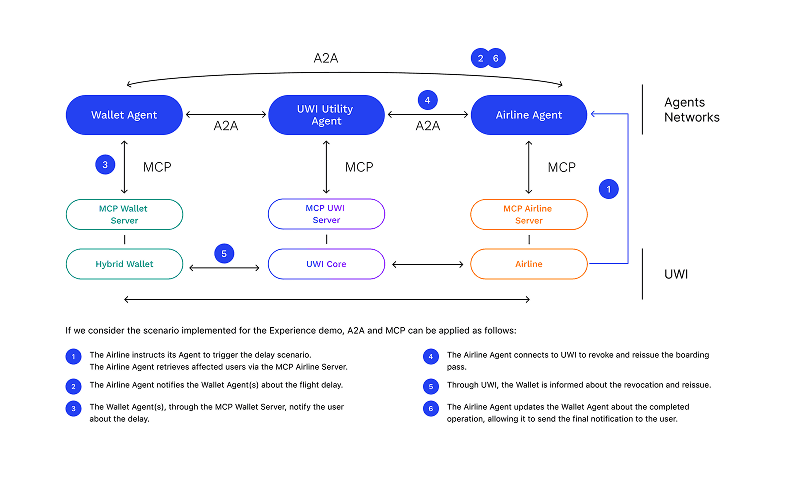
To illustrate how these components come together, let’s look at a real-world use case: a travel delay scenario involving an airline.
This example demonstrates how UWI, supported by protocols like MCP and A2A, enables seamless coordination between different types of agents. MCP (Model Context Protocol) provides the semantic layer that allows agents to interpret roles, tasks, and data in a consistent way. A2A (Agent-to-Agent) serves as the communication layer that allows agents to securely exchange information and delegate actions - enabling interaction, not between protocols, but between agents operating under them.
In this scenario, all three types of agents introduced earlier play a role:
1. The Service Provider Agent (operated by the airline) is instructed to trigger the delay scenario and identify impacted users via the MCP Airline Server.
2. It uses A2A to notify the relevant Wallet Agents about the delay.
3. Each Wallet Agent, via the MCP Wallet Server, notifies the user through their Hybrid Wallet.
4. The Service Provider Agent then interacts with the UWI Utility Agent to revoke and reissue the boarding pass.
5. The UWI Utility Agent, running on UWI Core, executes the revocation and reissuance and informs the Hybrid Wallet.
6. Finally, the Service Provider Agent updates the Wallet Agent, which sends the user final confirmation.
This example highlights the power of an agentic infrastructure built on UWI, where each agent type: Wallet, Service Provider, and Utility collaborate through standard protocols to deliver personalized, real-time outcomes with full automation and user consent.
The travel scenario above isn’t just a glimpse of the future, it’s a demonstration of what becomes possible when intelligent agents, verifiable data, and decentralized infrastructure work in harmony.
This vision translates into real value through UWI’s core capabilities. Its potential extends far beyond a single use case. UWI serves as a foundational layer for delivering quick, tangible value - powering scalable, hyper-personalized experiences across both enterprise and individual contexts through the following capabilities:
• For Enterprise
1. Democratic Data Infrastructure: Enterprises (Data Providers and Consumers) only store the minimal information required for compliance. Personal Data is controlled and shared by the Wallet Holders. This also means a reduction in security risks and an important liability reduction.
2. The ability to drastically reduce costs related to data verification that normally require custom and often manual processes
3. Adopt a new paradigm when it comes to sensitive and personal data storage and handling that can drastically ease compliance processes with evolving regulations
• For Wallet Holders
1. High Quality Data and Protection: Wallet Holders share verified data with and across enterprises to have their end-to-end processes recognized through verifiable credentials.
2. Consent and Delegation: Individuals maintain ongoing control over their data through clear, flexible permissions supporting trusted interactions that evolve over time and across contexts.
These capabilities aren’t just theoretical, they’re about to be in your hands. With these benefits clearly defined, the focus shifts to execution. UWI is going live with its first set of enterprise-ready services, built to accelerate agentic AI adoption by enabling secure access to trusted data and verifiable identity.
If you’re ready to lead, not follow, in the shift toward intelligent, trusted digital systems, now is the time to engage. Let’s make it work for your business.


Keep Exploring

Leadership Perspectives on Skills, Trust, and the Future of Learning

Frontline Perspectives on Heavy Industry with Alexander Diack