

Why Identity Infrastructure is the Foundation for Next-Gen Government Services
Unlocking Economic Growth and Seamless Citizen Experiences through Interoperable Digital Identity
Feb 20 2026
Introduction: The Hidden Friction in Government Services
Picture this: A parent applies for state childcare benefits in March. Come June, they need housing assistance - from the same government. Yet they're back to square one: uploading IDs, proof of address, income statements. The same documents. The same verification. Just a different portal.
Businesses face the same inefficiency. A company expanding into a new country or state spends months re-proving its legal existence to multiple agencies, submitting the same corporate documents over and over. Each agency operates its own verification silo, forcing redundant compliance checks that delay market entry and drain resources.
Multiply this friction across millions of citizens and businesses, billions of transactions, and you're looking at a massive economic drag hiding in plain sight. Identity verification sits at the foundation of every government service and commercial transaction. When that foundation is fragmented, everything built on top of it suffers - slower growth, higher costs, frustrated citizens, and stalled innovation.
To understand how to build the next generation of digital services, we first need to examine why our current identity systems are starting to hit their limits.

The First Wave: Lessons from the First Decade of Digital Identity Systems
The 2000s gave us our first glimpse of what digital identity could achieve. Estonia's e-ID system, Singapore's SingPass, and India's Aadhaar demonstrated that national-scale digital identity wasn't just feasible - it was transformative. These systems processed billions of transactions, dramatically reduced fraud, improved citizen experience, and lowered government operating costs.
They proved the concept works. But they also revealed the limitations of first-generation architecture.
These systems were built as walled gardens - centralized databases designed for security and control within a single jurisdiction. They excelled at organizing identity within their borders but struggled beyond them. No portability between systems, limited movement across public and private sectors, and no interoperability across countries. Single points of failure that created both security vulnerabilities and operational bottlenecks.
The legacy architectures behind these systems were built for the needs of their time - secure, centralized, and optimized for domestic use. Today, that reality has shifted. Economies are interconnected, mobility is high, and services are expected to work seamlessly across borders. The walls that once protected us now constrain us.
We need bridges, not higher walls.

The Second Wave: Decentralized Identity and Digital Wallets
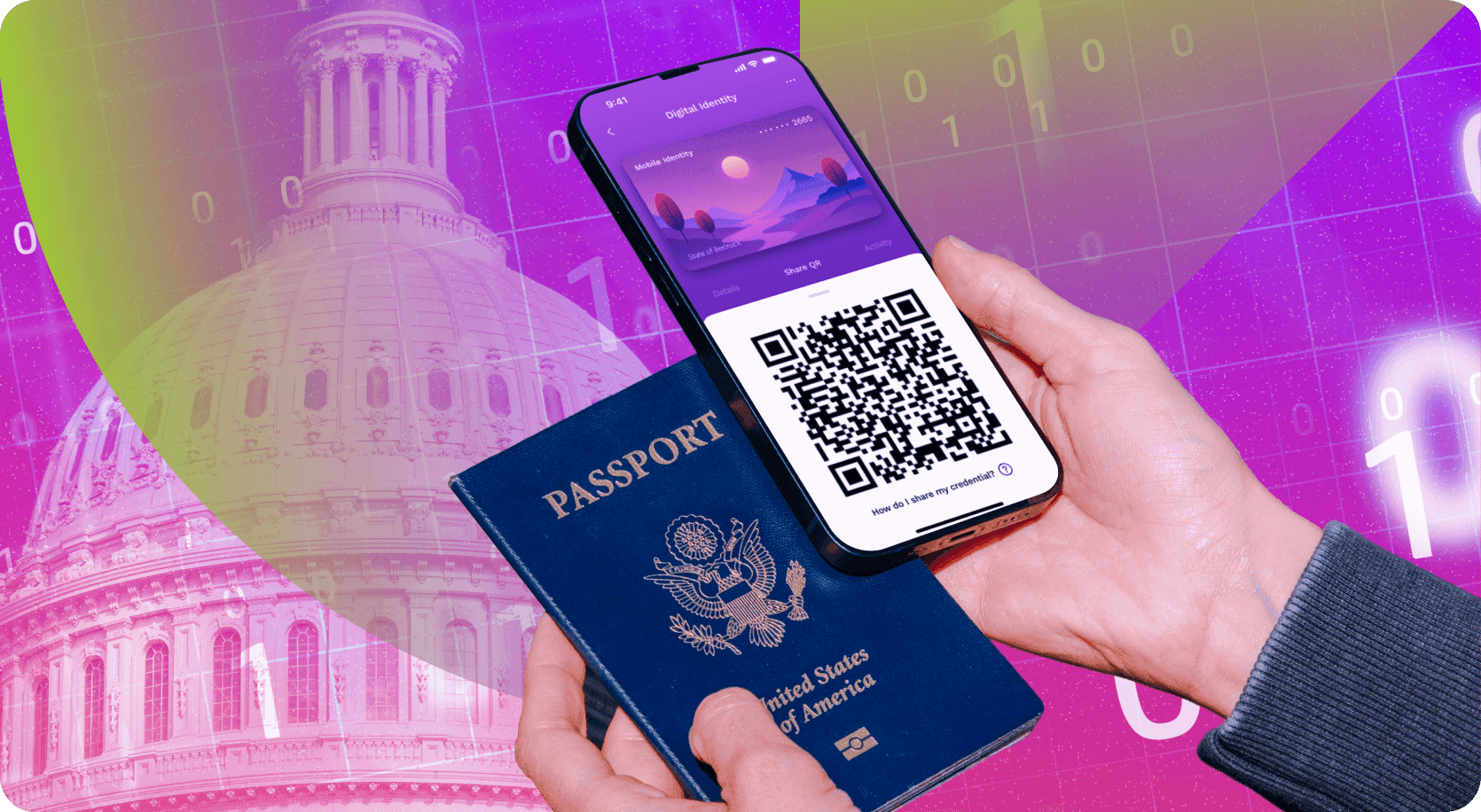
The next generation is already taking shape. Instead of storing identity data in central databases, governments are issuing cryptographically signed credentials that citizens hold in their secure and private digital wallets. The EU's eIDAS 2.0 framework, US mobile driver's licenses (mDLs), and similar initiatives worldwide represent a fundamental architectural shift - from centralized storage to distributed verification.
Digital wallets introduce an even more transformative opportunity: by 2029, over two thirds of the global population will store and use digital wallets for everyday interactions. The wallets will become a comprehensive credential repository holding multiple types of verifiable credentials: government IDs alongside professional licenses, educational certificates, employment records, and skill certifications.
The promise is compelling: seamless, instant verification across sectors and industries. A healthcare provider verifying a nurse’s license in seconds, a business onboarding customer without manual paperwork, a citizen accessing services across states without re-registering - all from the same wallet. Identity verification that becomes infrastructure, not friction.
But despite these promising new standards, governments are running into the same implementation challenges we’ve seen before. eIDAS 1.0 is an important lesson: it didn’t fail because digital identity lacked value, it failed because the rollout was inconsistent, expensive to maintain, and offered little relevance for the private sector. Without unified infrastructure, adoption stalled and the system never reached the scale it was designed for.
We’re now watching the same pattern re-emerge with Mobile IDs (mDLs). The TSA currently accepts mDLs from only a handful of states and only at certain airports, which means federal policy still requires travelers to carry a physical ID as backup. And as the DHS points out, the hard part isn’t building the digital ID itself - it’s aligning the entire ecosystem so states, agencies, banks, and businesses can all trust and verify the same digital signature. Without that shared trust layer, every deployment becomes a fragmented, state-by-state effort.
When acceptance isn’t universal, the consequences accumulate quickly. Governments invest millions into digital identity programs but see only a fraction of the expected return because usage remains low and agencies still need manual verification processes. Administrative workloads stay high, service delivery remains slower than expected, and the full value of digital transformation goes unrealized.
While frameworks like eIDAS 2.0 reflect meaningful progress - drawing directly from lessons learned in earlier iterations - standards alone are not sufficient to guarantee scale. Without shared infrastructure that enables consistent verification across the ecosystem, uptake remains fragmented and benefits fail to materialize uniformly.
Before these gaps widen further, we need infrastructure that makes interoperability the default state, not an aspiration.

The Need for Universal, Interoperable Identity Infrastructure
A successful solution must be:
Universally accepted across agencies, states, industries, and credential types without requiring custom integrations for each new connection.
Easily integrable so businesses can adopt it without massive technical overhauls that delay implementation by months or years.
Interoperable by design where systems communicate automatically eliminating the silos that force citizens and businesses to maintain separate credentials for every interaction.
This is precisely what Universal Wallet Infrastructure aims to enable. UWI intends to function as the connectivity layer that transforms isolated digital wallets into a coherent ecosystem. Governments issue credentials using open standards. Citizens choose their preferred wallets. Businesses integrate once and verify anywhere.
The result isn't just technical elegance - it's economic acceleration.
Identity Infrastructure as an Economic Catalyst
Interoperable identity infrastructure doesn't just improve government services - it catalyzes economic growth across every sector. When verification becomes instant and universally trusted, processes that once took weeks compress into seconds. Agencies spend less time on paperwork and more on delivering services. Fraud drops, administrative costs shrink, and citizen satisfaction rises as transactions finally move at the pace people expect.
The ripple effects extend into the broader economy. Businesses face fewer onboarding failures, compliance checks no longer stall expansion across state lines, and sectors like healthcare, financial services, and talent management operate with far greater efficiency. As activity increases, governments benefit from stronger local growth and more predictable revenue flows.

The Path Forward: Decisions that Define the Next Decade
The choices governments and businesses make today will determine whether tomorrow's economy runs on friction or flow.
For governments, the message is clear: stop treating identity as a compliance checkbox. Recognize it as foundational infrastructure - as essential as roads, power grids, or telecommunications networks. Build systems that connect rather than isolate. Make interoperability the default, not the exception. The ROI isn't just in cost savings; it's in unlocking economic velocity across your entire jurisdiction.
For businesses, priority should be to not wait for the perfect future to arrive - shape it. Push for open standards. Pilot wallet-based verification systems. Demand solutions that scale beyond jurisdictional borders. First-mover advantage in identity infrastructure translates directly to competitive advantage in market expansion, customer acquisition, and operational efficiency.
First-generation systems proved digital identity works at scale. Second-generation systems strengthened the underlying architecture. Now we need the third and most critical step: secure, interoperable identity infrastructure that removes friction from every transaction, for every participant, everywhere.
The technology exists. The standards are maturing. The economic case is undeniable. What's missing is the collective will to build infrastructure instead of isolated solutions.
The question is no longer whether this transformation will happen - it is how quickly institutions choose to lead in shaping it.
References
Corbado. Digital Identity Verification Solutions for a Secure World. Retrieved from [link]
Entrust. 2025 Identity Fraud Report. Retrieved from [link]
Corbado. Digital Identity 101: A Beginner’s Guide for 2026. Retrieved from [link]
MDPI. The eIDAS Regulation: A Survey of Technological Trends for European Electronic Identity Schemes. Retrieved from [link]
Corbado. Mobile Driver's License are here: ultimate Guide to mDLs. Retrieved from [link]
IEEEAccess. Challenges in Implementing Cross-Border Digital Identity Systems for Global Public Infrastructure: A Comprehensive Analysis. Retrieved from [link]
World Economic Forum. How universal wallets can help businesses unleash the full potential of digital identity. Retrieved from [link]
Scytaled. The Impact of Digital Identity Wallets on Businesses and Consumers. Retrieved from [link]
PingIdentity. AI Agents & IAM: A Digital Trust Dilemma. Retrieved from [link]
HICSS. Towards Inclusive Digital Transactions: Disability and The Case of Singapore’s Singpass App. Retrieved from [link]
Moneylife. Aadhaar Is a Flawed, Risky Model for Digital ID, Civil Society Groups Issue International Warning. Retrieved from [link]
Republic of Estonia e-Residency. important updates to e-residency: what’s changing in 2025 and beyond. Retrieved from [link]
US Department of Homeland Security. Feature Article: Implementing Mobile Driver’s Licenses: Not as Easy as You Think. Retrieved from [link]
Semiengineering. The Evolution Of eIDAS: Past, Present, And Future. Retrieved from [link]
Juniper Research. Over Two Thirds of the Global Population to Own a Digital Wallet by 2029. Retrieved from [link]


Keep Exploring

Leadership Perspectives on Skills, Trust, and the Future of Learning

Frontline Perspectives on Heavy Industry with Alexander Diack